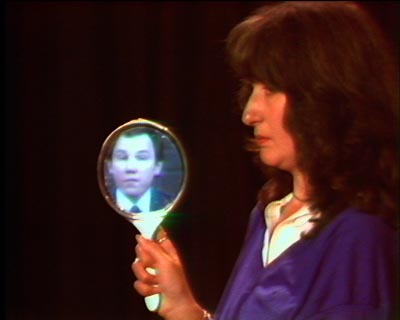
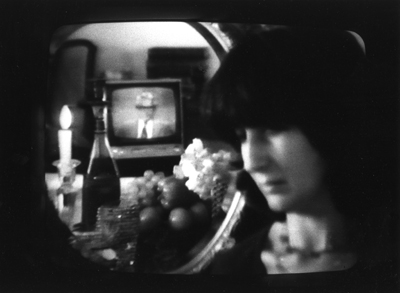
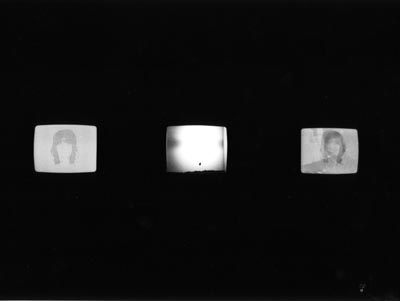
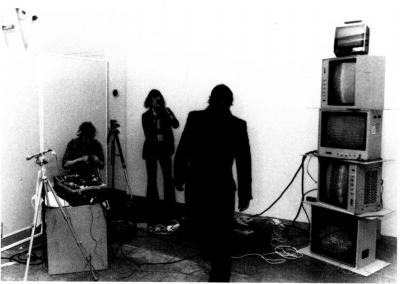
The idea of using the ‘Vanitas’ theme in Krikorian’s work came originally from a painting which she saw in the Ashmolean museum in Oxford. The title of the 17th century painting is Allegory of Justice and Vanitas; in which a woman is seated holding a mirror, which is facing the spectator. A number of still life objects including a skull and a candlestick denoting the transience of life are reflected in the mirror. In other Vanitas paintings, …
Continue reading “Vanitas (Or an Illusion of Reality)”
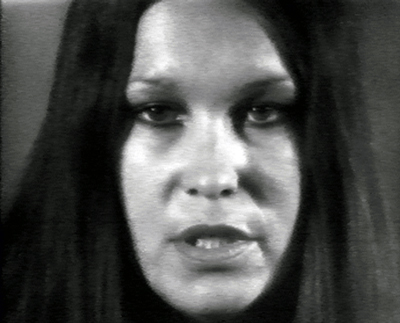
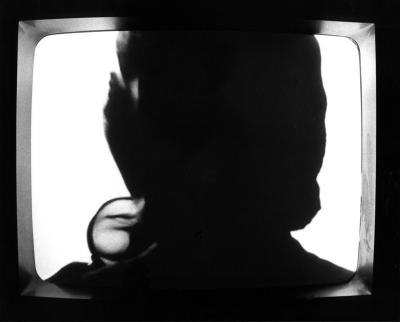
This is a Video Monitor is an attempt to construct a wholly ‘videological’ experience, and is built on an initial take of a woman* describing the paradox of real and imagined functions of the monitor on which her image appears…
Sound synchronisation wavers as she mimes to her pre-recorded voice – an analogy to part of her description. The camera cuts at the end of the first take and a no-signal ‘snow-field’ …
Continue reading “This is a Video Monitor (1974)”
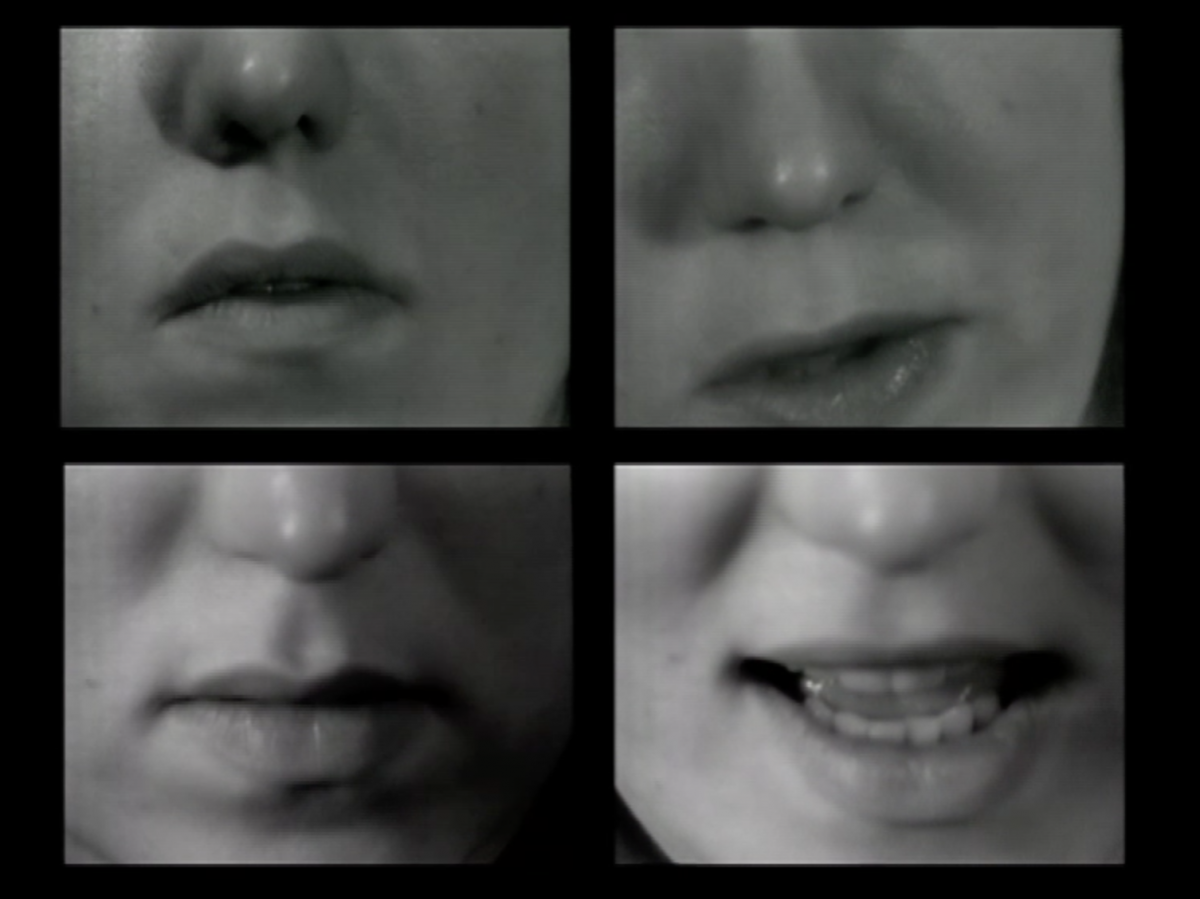
‘Dialogue for four players is a video playback installation by Steve Partridge at the AIR Gallery during Mid-March. Four Monitors stand in a square facing the viewer in a darkened room: their own light is the only illumination. Each monitor is replaying a different tape; each showing the lower half of (the same?) woman’s face, thus each speaks its own contribution to the dialogue.
The Four tapes are fifteen minutes long, they are played simultaneously, …
Continue reading “Dialogue For Four Players (1978)”
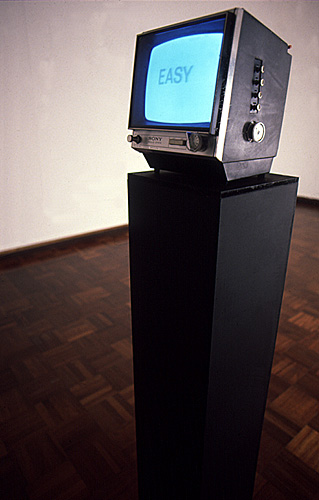
‘Easy Piece was originally intended to be shown as an installation but it was not until 1996 that I actually got around to showing in that form.’ Stephen Partridge
“Partridge’s first works, which still hold good today, and continue to inspire new generations who see them, were essentially performance pieces. This was before the age of edit-suites, when crude splicing was the only option to straight duration and when all video-pictures were grey and visibly ‘degraded’. …
Continue reading “Easy Piece (1974)”
Catalogue for Biddick Farm Artists Video 1977 pdf here
“Of the origins of In the Mind’s Eye (1977) she (Tamara Krikorian) wrote:
“I thought about ways of approaching formalism through some sort of restricted narrative, and I used Rimbald’s poem ‘In Winter’ [describing a railway journey] as the structure of the work, while retaining obvious self-referral devices…concerned with the perception of video/TV per se.’
We hear her read the poem in French, …
Continue reading “In the Mind’s Eye”
“In Unassembled Information (1977) the screen is dominated by the back of her head, past which can be glimpsed fragments of her face in the small mirror she is holding, while a radio is playing. Thus she negated the elaborately constructed image of the TV presenter; with the radio a reminder of importance of the spectator’s imagination, so rarley addressed by television.”
David Curtis, A History of Artists’ Film and Video in Britain. British Film Institute, …
Continue reading “Unassembled Information”
“Vanitas came after seeing a French painting attributed to Nicolas Tournier at the Ashmolean Museum, Oxford, An Allegory of Justice and Vanity . Vanitas is a self-portrait of the artist and at the same time an allegory of the ephemeral nature of television.’ – Tamara Krikorian 1978
Above statement written by the artist on Vanitas, single-screen installation.
Vanitas installed at the REWIND Soft Launch 2006
Restaged for the REWIND Soft Launch at DCA, …
Continue reading “Vanitas (1976)”
‘An Ephemeral Art, an installation by Tamara Krikorian’, article written by Krikorian in March 1979.pdf here
Statement about ‘An Ephemeral Art’, written by Tamara Krikorian.pdf here
Leaflet for the exhibition ‘Eye to Eye: Two installations by Tamara Krikorian’, The Frutmarket Gallery, Edinburgh, 20 October – 17 November 1979. Includes works ‘Vanitas’ and ‘Tableau’.pdf here
Leaflet advertising ‘The heart of the illusion: Landscape, …
Continue reading “An Ephemeral Art”