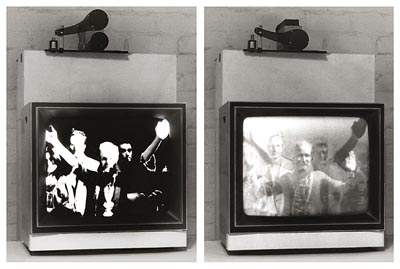
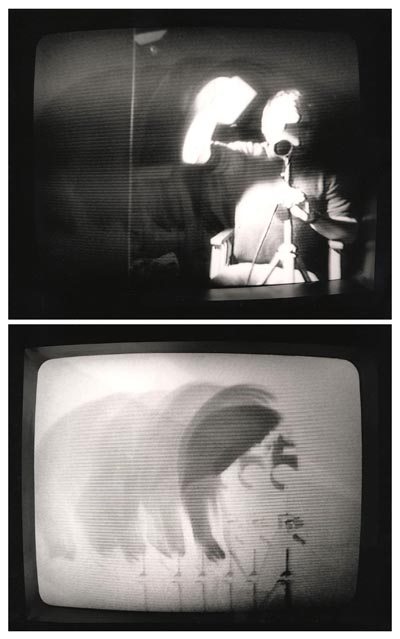
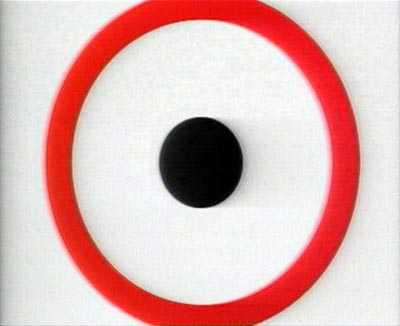
‘Over-lighting exceeds capacity for assimilation in a 1970s video camera and images are ‘burnt’ into the surface of its tube. Here a unique property is discovered where both the passage of time and trace of that continuum are registered as one. A section of the original tape version records the image of the artist with a camera (via a mirror) panning, by stages, across the screen. Before movement the lens is covered and re-exposed after the change, …
Continue reading “Vidicon Inscriptions (1976 Installation)”
‘Over-lighting exceeds capacity for assimilation in a 1970s video camera and images are burnt into the surface of its ‘vidicon’ tube. Here a unique property is explored where both the passage of time and trace of that continuum are registered as one… In this, the original tape, one of three sections records the image of the artist with a camera (via a mirror) panning, by stages, across the screen. Before movement the lens is covered and re-exposed after the change, …
Continue reading “Vidicon Inscriptions (The Videotape 1976)”
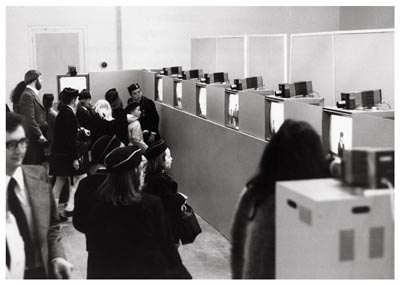
‘A live interactive installation (using no recording equipment) which, as the participant moves through, progressively separates and distances his/her image from its origin.’ David Hall 1974
‘Many early installations were devised as a complex analogical mirror where the viewer, interacting with his/her image as collaborator rather than spectator, was simultaneously the viewed in a process of ‘self-referring consciousness’. It is quite evident here that artists were intent on exploring relationships of hitherto unapproachable psychological innovation and response, …
Continue reading “Progressive Recession (1974)”
Leaflet advertising a weekend of video events at Serpentine Gallery, London. Includes a screening of Steve Littman’s ‘Crisps’.pdf here
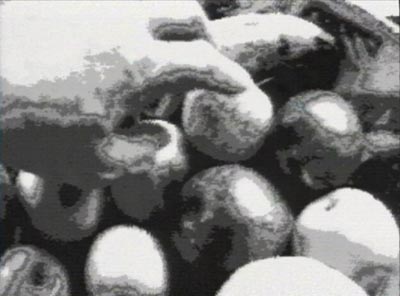
Stills from Crisps, 1980, 4 mins.pdf here
Art statement for ‘Crisps – 1980 4 mins’, includes information on the production process, editing process and post production systems.pdf here …
Continue reading “Crisps”
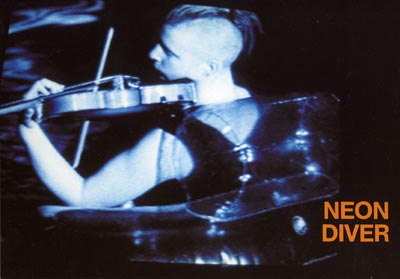
Postcard for ‘Neon Diver’, 1990 pdf here.
‘Neon Diver’, British Films 1991 pdf here. …
Continue reading “Neon Diver”
Announcement of the transmission of John Latham’s Video works for Channel Four television’, Annalogue, 1984. pdf here
Riverside Studios ‘Dadarama & Ian Breakwell’s Diaries’ – Artists’ works for Channel 4 Television, 1985. Featuring Target pieces by John Latham. pdf here …
Continue reading “Nmutter”
“The film and video artist Malcolm Le Grice (1940-, UK) has written about the issues raised by the emergence of the non-linear manipulation and its implications for film and video from ideas that have emerged from his own fine art practice, including a sustained period of working with accessible digital technology. In work such as Arbitrary Logic (1986), Sketches for a Sensual Philosophy (1988) and Digital Still Life (1989), Le Grice worked with inexpensive home computers (initially the Sinclair Spectrum and the Atari) to explore the potential of the digital and its implications for moving image within a fine art context.” …
Continue reading “Arbitrary Logic”
‘The Independents’ – Co-presented by The Art gallery of Ontario and Cinematheque Ontario. Programme of events including a talk by Malcolm LeGrice and screening of ‘Digital Still Life’.pdf here
Stills from the video work ‘Digital Still Life’.pdf here …
Continue reading “Digital Still Life”